
Where Should I Install a Standby Generator Around My Home?
July 28, 2026A standby generator should be installed outside the home on a stable, level surface in a location that allows open airflow, safe exhaust direction, service access, proper drainage, and practical connection to the home’s electrical and fuel systems. The best location depends on the generator model, home layout, transfer switch location, fuel source, manufacturer requirements, local code, and site conditions.
For most homeowners, the right standby generator placement is not simply the most open spot in the yard. The location affects safety, performance, maintenance access, noise, drainage, utility connections, and how reliably the system can support the home during an outage.
Tri-State Water, Power & Air installs standby generators outside the home using licensed technicians. These systems run on natural gas or propane and are designed to turn on automatically when utility power goes out. Before a home generator installation, a professional site evaluation helps determine where the generator should go, what size system makes sense, and how the unit should connect to the home.
Quick Answer: Where Is the Best Place to Put My Standby Generator?
The best place to install your standby generator is outside the home on a level, stable floor pad with open ventilation, safe exhaust direction, clear maintenance access, and practical connection to the transfer switch and fuel source. Final home generator placement should follow manufacturer requirements, local code, utility rules, and a site evaluation by a professional generator technician.
A generator location that works well for one home may not work for another. Every property has different windows, vents, doors, utility locations, grade changes, landscaping, property lines, fences, drainage patterns, and fuel access. That is why standby generator placement should always be reviewed on site before installation.
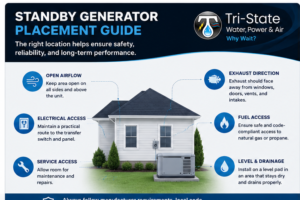
Standby Generator Placement Checklist
Before a standby generator is installed, the placement area should be evaluated for safety, access, and long-term performance. A professional installer will look at more than just available yard space.
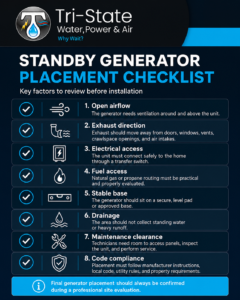
Use this checklist to review key placement factors before a standby generator is installed:
-
Open airflow: The generator needs ventilation around and above the unit.
-
Exhaust direction: Exhaust should move away from doors, windows, vents, crawlspace openings, and air intakes.
-
Electrical access: The unit must connect safely to the home through a transfer switch.
-
Fuel access: Natural gas or propane routing must be practical and properly evaluated.
-
Stable base: The generator should sit on a secure, level pad or approved base.
-
Drainage: The area should not collect standing water or heavy runoff.
-
Maintenance clearance: Technicians need room to access panels, inspect the unit, and perform service.
-
Code compliance: Placement must follow manufacturer instructions, local code, utility rules, and property requirements.
The above checklist is a helpful starting point, but it should not replace a professional generator site evaluation. The final location should be based on the specific generator model, fuel source, home layout, and local installation requirements.
Why Standby Generator Placement Is Important
A standby generator is a permanent backup power system. Unlike a portable generator, it is not moved around when storms or outages happen. It is installed outside the home, connected to a fuel source, and integrated with the home’s electrical system through a transfer switch.
That permanent home generator setup is what makes a standby generator convenient. When utility power fails, the system can detect the outage, start automatically, and provide backup power to selected circuits or the full home depending on how the system is sized and configured.
Placement matters because the generator must be able to operate safely and reliably during an outage. Poor standby generator placement can restrict airflow, direct exhaust toward the home, create drainage problems, complicate service, increase installation difficulty, or interfere with fuel and electrical connections.
A well-planned whole-house generator site helps support:
-
Clear outdoor ventilation
-
Safer exhaust management
-
Reliable electrical integration
-
Practical propane or natural gas routing
-
Better access for service and maintenance
-
Protection from standing water and drainage issues
-
Code-compliant installation planning
-
Long-term generator performance
For homeowners considering a whole-home backup power system, placement should be part of the planning process from the beginning.
Does a Standby Generator Need to Be Installed Outdoors?
Standby generators are outdoor systems. They create exhaust, generate heat, and require open ventilation. Even though they are professionally installed and permanently connected, they still need to be placed where exhaust can move safely away from the home.
A standby generator should not be installed in a garage, basement, crawlspace, shed, porch enclosure, breezeway, or any partially enclosed space. These areas can restrict airflow and create serious exhaust concerns.
Generator exhaust should also be kept away from doors, windows, vents, crawlspace openings, and fresh-air intakes. Opening windows, using fans, or placing the generator “mostly outside” does not solve the issue if exhaust can still enter the home.
The safest approach is to choose an outdoor location with clear ventilation, proper clearance, and a layout that allows exhaust to move away from the structure.
How Close Can a Standby Generator Be to a House?
A standby generator can often be installed relatively close to a home compared with a temporary portable generator, but the exact distance depends on the generator model, manufacturer instructions, wall materials, local code, exhaust direction, nearby openings, and site layout.
There is no single distance that applies to every home or every standby generator. A location that appears convenient may not work if it is too close to a window, soffit vent, dryer vent, crawlspace opening, gas meter, fence, deck, property line, or other equipment.
Homeowners should be careful with generic online clearance advice. Some clearance recommendations may apply to one model or one jurisdiction, but not another. The final placement should always be confirmed by a qualified generator installer who can review the specific property and generator requirements.
Our professional generator installation technicians know when a location meets manufacturer clearance requirements, local code, airflow needs, exhaust safety standards, and service access requirements. The exact distance will be confirmed during a professional site evaluation.
Standby Generator Placement Requirements
Every home has different installation conditions. Some properties have open side yards with easy access to utilities. Others have narrow setbacks, fencing, low windows, decks, patios, drainage issues, utility conflicts, or HOA or local regulations and restrictions.
A professional standby generator installation should account for the full site, not only the generator’s physical footprint.
Consider Airflow and Exhaust Direction
Airflow is one of the most important placement factors. A standby generator needs open ventilation around the unit so it can operate properly. It should not be crowded by shrubs, fencing, walls, storage bins, patio furniture, or other obstructions.
Exhaust direction also matters. The generator should be placed where exhaust can move away from the home instead of toward doors, windows, vents, soffits, crawlspace openings, or air intakes. This is especially important during severe weather, when windows may be closed but ventilation paths, vents, and other openings still exist.
Generator Manufacturer Clearance Requirements
Standby generator clearance requirements vary by model. Manufacturer instructions may include specific spacing from walls, openings, equipment, combustible materials, and overhead structures.
This is one reason homeowners should not choose a final location based only on appearance. A generator may look like it fits beside the home, but the manufacturer’s requirements may call for additional clearance around the unit.
Connecting the Generator Transfer Switch and Electrical Access
A standby generator connects to the home’s electrical system through a transfer switch. The transfer switch allows the home to safely move between utility power and generator power during an outage.
Because of this, electrical access is an important part of placement. A shorter, more direct electrical route may be practical in some homes. However, the closest location to the electrical panel is not always the best location for the generator.
Fuel access, exhaust direction, ventilation, drainage, service clearance, and property requirements may all matter just as much as the electrical route.
Natural Gas or Propane Access
Tri-State standby generators run on natural gas or propane. That means the generator location must support proper fuel routing.
In some homes, placing the generator near the gas meter or propane source may make installation more practical. In other cases, that location may create clearance, exhaust, access, or drainage concerns.
Fuel access should be evaluated by professional generator technicians. Natural gas and propane systems may require review for fuel line sizing, meter capacity, tank placement, routing, and compatibility with the selected generator.
Drainage and Ground Conditions for Generator Placement
A standby generator should be installed on a stable, level base. The exact pad or base requirement depends on the generator model, soil conditions, manufacturer specifications, and local installation standards.
Drainage is especially important. A low area that collects water during heavy rain is usually not a good location. The installer should also consider downspouts, roof runoff, grading, hardscaping, and soil movement.
A generator location should remain stable and accessible before, during, and after severe weather. If the area is difficult to reach when wet, icy, or covered with storm debris, it may create service problems later.
Home Generator Maintenance and Service Access
Generator placement should support long-term maintenance. A standby generator may need inspections, testing, oil and filter service, battery checks, diagnostics, repairs, and parts replacement throughout its service life.
If the unit is placed in a cramped area, blocked by shrubs, or closed in by fencing, service becomes harder. Technicians need room to open panels, inspect components, test the system, and work safely around the equipment.
This is also important after installation. Homeowners should avoid adding landscaping, storage items, decorative screens, or fencing too close to the generator unless clearance has been reviewed.
Where Not to Install a Standby Generator
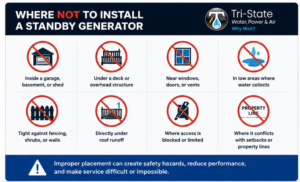
Some areas around the home may look convenient but should be avoided. Unsafe or impractical generator placement can reduce airflow, increase exhaust risk, create drainage problems, interfere with utilities, or block service access.
A standby generator should generally not be installed:
-
Inside a garage, basement, crawlspace, shed, or enclosed porch
-
Under a deck or structure that restricts exhaust or service access
-
Near doors, windows, vents, or fresh-air intakes
-
In a low area where water collects
-
Tight against fencing, shrubs, walls, or stored equipment
-
Directly under heavy roof runoff
-
Where technicians cannot safely access the unit
-
Where it conflicts with fuel equipment, utility meters, property lines, or local setback rules
The goal is not only to place the generator outdoors. The goal is to place it outdoors in a location that supports safe airflow, exhaust direction, electrical connection, fuel access, drainage, and future maintenance.
Can a Standby Generator Be Installed in a Side Yard?
A side yard can be a practical location for a standby generator when it provides enough clearance, airflow, drainage, and service access. Many homes have utility areas along one side of the house, which can make the side yard a logical place to evaluate.
However, a side yard is not automatically the right choice. Some side yards are too narrow. Others are blocked by fences, shrubs, gates, air conditioning equipment, downspouts, windows, crawlspace openings, or property-line restrictions.
A side yard also needs to stay accessible after installation. If landscaping, trash bins, storage items, or fencing are added later, they can restrict airflow or make the generator harder to service.
For homes across Tri-State Water, Power & Air’s service areas, property layouts can vary widely. A dense neighborhood lot, suburban home, rural property, and larger residential site may all require different placement strategies.
Can a Standby Generator Be Installed Behind the House?
A standby generator can sometimes be installed behind the home if the area provides proper clearance, airflow, drainage, fuel access, electrical access, and service space. The back of the home may offer more open space than a narrow side yard and may keep the unit away from street-facing views.
However, the rear of the home still needs to be reviewed carefully. Decks, patios, sliding doors, windows, crawlspace vents, landscaping, roof runoff, fencing, and drainage patterns can all affect whether the location works.
A rear-yard location may be visually preferred, but it is not always the most practical installation option. If it creates long utility routes, service access problems, or clearance conflicts, another location may be better.
Should a Standby Generator Go Near the Electrical Panel?
A standby generator does not always need to be placed directly beside the electrical panel, but electrical access is an important part of the installation plan. The generator must connect to the home through a transfer switch, which allows the electrical system to safely use generator power during an outage.
In some homes, a location near the electrical panel or transfer switch can simplify installation. In other homes, that location may not be suitable because of windows, vents, gas equipment, drainage, fencing, or clearance restrictions.
A professional site evaluation helps balance electrical access with the rest of the placement requirements. The best generator location should support safe electrical integration without compromising airflow, exhaust direction, fuel access, or maintenance clearance.
Should a Standby Generator Go Near the Gas Meter or Propane Tank?
A standby generator may be installed near a gas meter or propane source when the location meets fuel, clearance, airflow, exhaust, drainage, and code requirements. Fuel access is important, but it should not be the only deciding factor.
Natural gas and propane systems may need to be reviewed to confirm whether they can support the selected generator. The installer may need to evaluate fuel line routing, fuel line sizing, meter capacity, propane tank considerations, and safe connection points.
The best placement plan considers fuel access and electrical access together. A location that is convenient for fuel may not work if it creates exhaust, drainage, or service access problems.
What Happens During a Standby Generator Site Evaluation?
A standby generator site evaluation helps determine where the generator should go and what type of system makes sense for the home. Tri-State Water, Power & Air offers site evaluations to help homeowners select the right standby generator and installation plan.
During the evaluation, a generator specialist may review the homeowner’s backup power goals. Some homeowners want to power essentials such as refrigeration, lights, medical equipment, security systems, or select appliances. Others want broader whole-home backup power.
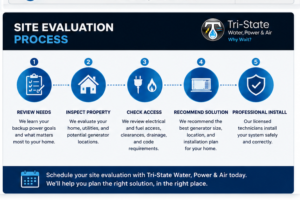
The site evaluation may also include a review of possible generator locations around the property. The specialist can evaluate doors, windows, vents, wall openings, grade, drainage, utility access, fuel source, transfer switch location, service clearance, and visual preferences.
A professional home generator site evaluation may include:
-
Reviewing what the homeowner wants to power
-
Inspecting possible generator locations around the home
-
Checking airflow, exhaust direction, and clearance conditions
-
Reviewing natural gas or propane access
-
Evaluating transfer switch and electrical connection needs
-
Looking at grade, drainage, and pad placement
-
Identifying service access requirements
-
Recommending a practical installation plan
This generator site evaluation process helps homeowners avoid guessing. Instead of choosing a spot based only on appearance, the site evaluation considers the full installation plan.
Home Standby Generator Placement FAQs
Can a standby generator be installed next to a house?
A standby generator may be installed near a house when the location meets manufacturer requirements, local code, airflow needs, exhaust safety requirements, and service access requirements. The exact distance depends on the generator model and installation conditions, so the final location should be confirmed by a professional installer.
Can a standby generator be installed under a deck?
A standby generator should not be installed under a deck if the location restricts airflow, traps exhaust, limits clearance, or blocks service access. Any overhead structure should be reviewed by a professional installer before the location is considered acceptable.
Can a standby generator be installed near a window?
A standby generator should not be installed where exhaust can enter a window, door, vent, crawlspace opening, or fresh-air intake. The exact required distance depends on the generator model, local code, and manufacturer instructions.
Can landscaping be placed around a standby generator?
Landscaping can be placed near a standby generator only if it does not block airflow, exhaust, or technician access. Shrubs, mulch, fencing, decorative screens, and plants should be planned around manufacturer-required clearance.
Does a standby generator need a concrete pad?
A standby generator needs a stable, level base, but the exact pad requirement depends on the generator model, manufacturer instructions, soil conditions, and local installation standards. Some installations may use a concrete pad, while others may use an approved generator pad.
Can a standby generator be installed in a fenced yard?
A standby generator may be installed in a fenced yard if the fence does not restrict airflow, trap exhaust, block service access, or violate clearance requirements. Gate access should also be considered so technicians can reach the unit for maintenance or emergency service.
Can I choose where my standby generator goes?
Homeowner preference matters, but the final location must meet safety, code, manufacturer, electrical, fuel, drainage, and service requirements. A professional installer can review preferred locations and explain which options are practical.
How far should a standby generator be from the electrical panel?
There is no single required distance that applies to every home. Electrical access is important because the generator connects through a transfer switch, but placement also depends on fuel access, ventilation, exhaust direction, drainage, and code requirements.
Does generator placement affect installation cost?
Generator placement can affect installation complexity. Fuel routing, transfer switch location, trenching, meter considerations, pad preparation, permits, and site access can all influence the overall installation plan.
Who decides the final standby generator location?
The final standby generator location is typically determined through a professional site evaluation. The home generator installer considers manufacturer instructions, code requirements, utility access, fuel access, electrical connection needs, drainage, ventilation, service clearance, and homeowner preferences.
Schedule a Standby Generator Site Placement Evaluation with Tri-State Water, Power, and Air
Choosing where to install a standby generator is one of the most important parts of planning a reliable backup power system. The right location should support safe airflow, proper exhaust direction, practical fuel and electrical connections, stable ground conditions, and future service access.
Tri-State Water, Power & Air generator dealerships across the Mid South can help homeowners evaluate the best standby generator location for their property. During a site evaluation, Tri-State’s generator specialists can review your backup power goals, inspect possible installation areas, explain generator options, and help determine the right setup for your home.
If you are considering a home unit, schedule a standby generator site evaluation with Tri-State Water, Power & Air or call 877-301-7693 to speak with the professional generator installation team.